Freemasons and their association with ancient Egyptians
The Freemasons, one of the world’s oldest fraternal organisations, has long fascinated historians, conspiracy theorists, and the public. Founded in the early 18th century, the Freemasons claim a heritage that spans back through centuries, with some members and scholars suggesting links to the ancient Egyptian civilization. The Freemasons have drawn from Egyptian symbolism, myths, and architectural achievements. This association largely reflects how the Freemasons have sought to integrate ancient wisdom into their rituals, philosophy, and iconography rather than implying a concrete historical lineage.
Origins and Symbolism in Freemasonry
The origins of Freemasonry as we know it today trace back to the medieval stonemasons’ guilds in Europe, particularly in England and Scotland. These guilds, composed of skilled builders, held considerable influence due to their architectural expertise, and they developed secret signs, handshakes, and other symbols to identify themselves as trained craftsmen. Over time, as the need for literal stonemasons diminished, these guilds transformed into “speculative” Freemasonry. No longer focused on building with stone, speculative Freemasons adapted the guild’s practices to the cultivation of ethical principles and self-improvement.
Central to Freemasonry is the use of symbols, many of which are derived from ancient mythologies and esoteric teachings. Freemasons employ symbols such as the square, compass, and all-seeing eye—items that symbolise moral and philosophical lessons rather than material building tools. These symbols often resonate with the imagery and mystique associated with ancient Egyptian culture, which was deeply symbolic in its own religious and architectural practices.
Egyptian Influence in Freemasonry’s Symbolism
Egypt has long held a particular allure for the Freemasons, partly because of the reputation of Egyptian civilization as a source of ancient wisdom and mystery. During the Renaissance, Western scholars rediscovered ancient texts and teachings, including those from Egypt, sparking renewed interest in ancient esoteric knowledge. In particular, the mythological figure of Hermes Trismegistus, associated with both Greek and Egyptian knowledge, became a symbol of wisdom and became intertwined with Masonic traditions.
One example of Egyptian influence is the Masonic use of the “All-Seeing Eye” or “Eye of Providence,” an emblem that resembles the ancient Egyptian Eye of Horus. In Egyptian mythology, the Eye of Horus was a powerful symbol of protection, health, and royal power. For the Freemasons, the All-Seeing Eye represents divine watchfulness, often symbolising God’s omnipresence, or “The Great Architect of the Universe,” observing and guiding humanity.
Freemasonry also draws inspiration from Egyptian architectural practices, particularly the pyramids. The ancient Egyptians constructed pyramids with precise mathematical and architectural knowledge, which aligns with the Freemasons’ high regard for geometry and architectural precision. The famous Masonic phrase “As above, so below,” often attributed to the Hermetic texts, captures the Freemason’s fascination with the order and symmetry of the universe, ideas that resonate with Egyptian reverence for cosmic order (Ma’at) and balance.
The Freemasons and the Egyptian Mystery Schools
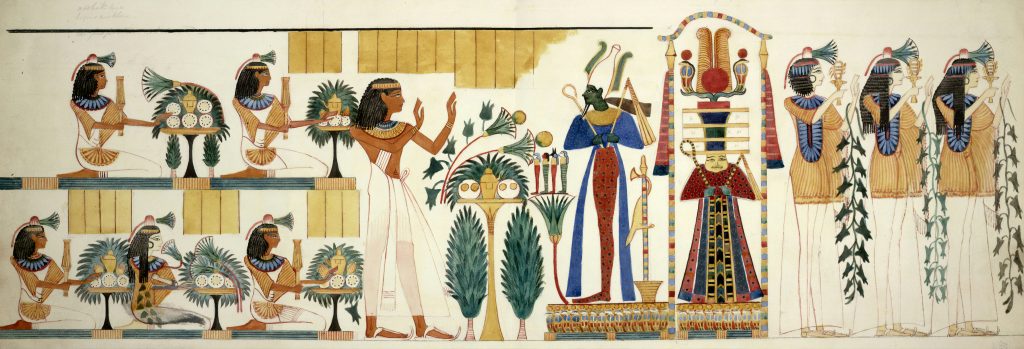
Another layer of connection is the Freemasons’ interest in the concept of “mystery schools,” which are said to have existed in ancient Egypt to educate initiates in spiritual and philosophical knowledge. While it is unlikely that the Freemasons directly inherited teachings from Egyptian mystery schools, they may have drawn inspiration from the idea of secret knowledge and initiatory rites. Egyptian priests were believed to be initiated into various levels of sacred knowledge, each level bringing them closer to divine wisdom. This structure is similar to the degrees of initiation in Freemasonry, where members progress through stages to gain deeper understanding.
In Freemasonry, each degree of initiation is marked by specific rituals, symbols, and teachings. These degrees often involve elaborate rituals that are reminiscent of ancient rites, although they are not strictly Egyptian in origin. Nonetheless, the Freemasons’ emphasis on wisdom, morality, and initiation is sometimes portrayed as a continuation of the mystical pursuit of knowledge that ancient Egyptians are believed to have cherished. Whether or not these rituals are genuinely derived from Egyptian practices, the thematic resemblance serves to imbue Freemasonry with a sense of ancient lineage.
The Masonic Obsession with Egypt in the Modern Era
During the late 18th and early 19th centuries, European society experienced an “Egyptomania,” sparked by Napoleon’s expeditions in Egypt and the subsequent archaeological discoveries, including the Rosetta Stone. Freemasons, too, were captivated by the mysteries of ancient Egypt, and Egyptian motifs began to proliferate in Masonic lodges. Lodges across Europe and America incorporated obelisks, pyramids, and other Egyptian motifs into their architecture, and some Masonic rituals began explicitly referencing Egyptian gods, pharaohs, and symbols.
In America, the influence of Egypt is evident in the architecture of Masonic buildings and even in Washington, D.C., where the layout and certain landmarks, such as the Washington Monument, have been interpreted by some as evidence of Masonic influence shaped by Egyptian themes. However, these connections are often more symbolic than literal, representing the Freemasons’ fascination with the perceived wisdom of ancient civilizations rather than any factual continuity.
Egypt as a Source of Inspiration
While the Freemasons have undeniably borrowed from Egyptian symbolism and themes, the association between the two is more about inspiration than direct lineage. Ancient Egypt represents an idealized past that Freemasons look to as a source of timeless wisdom and mystery. The symbolic use of Egyptian motifs, the incorporation of esoteric principles, and the emphasis on initiation align with the Freemasons’ commitment to self-improvement, moral philosophy, and unity under universal principles. Ultimately, the Freemasons’ connection to ancient Egypt is a fusion of mythology, symbolism, and philosophical borrowing, rather than a direct descent from Egyptian priests or architects.